2.0060 is the German material number for Cu-ETP, electrolytic tough pitch copper, known under the old DIN 1787 name E-Cu57. It is the most common high-conductivity copper in Europe and is equivalent to EN CW004A, UNS C11000, JIS C1100 and Chinese T2. This page gives its composition, properties, equivalent grades, the difference between E-Cu57 (2.0060) and E-Cu58 (2.0065), and practical tips for CNC milling and turning it.
Quick Answer: 2.0060 / E-Cu57 at a Glance
| Item | Value |
|---|---|
| Material number | 2.0060 |
| Designation | Cu-ETP (old DIN: E-Cu57) |
| EN number | CW004A |
| US equivalent | UNS C11000 (ETP copper) |
| Copper content | ≥ 99.90% (incl. Ag) |
| Oxygen | Up to about 0.04% |
| Density | 8.94 g/cm³ |
| Electrical conductivity | ≥ 57 MS/m (about 98–101% IACS depending on temper) |
| Thermal conductivity | About 390 W/m·K |
| Melting point | About 1,083 °C |
| Machinability | About 20% of free-cutting brass: soft and gummy |
2.0060 Material Equivalents
| Standard | Designation |
|---|---|
| EN / ISO | Cu-ETP, CW004A |
| DIN (old) | E-Cu57 (2.0060); E-Cu58 (2.0065) |
| ASTM / UNS | C11000 |
| JIS | C1100 |
| GB (China) | T2 |
| BS (old) | C101 (do not confuse with UNS C10100, which is oxygen-free copper) |
E-Cu57 vs E-Cu58: 2.0060 vs 2.0065
Both are electrolytic tough pitch copper. Under the old DIN 1787 standard, the number in the name was the guaranteed minimum electrical conductivity in m/(Ω·mm²), which is the same as MS/m: E-Cu57 (2.0060) guaranteed at least 57 MS/m and E-Cu58 (2.0065) at least 58 MS/m, which corresponds to 100% IACS. In the current EN standards both are covered by Cu-ETP (CW004A), and most CW004A material today reaches 58 MS/m. If conductivity is critical, specify the minimum value on your drawing.
Related Copper Grades
| Material no. | Old DIN name | EN | Type | When to use it |
|---|---|---|---|---|
| 2.0060 / 2.0065 | E-Cu57 / E-Cu58 | Cu-ETP, CW004A | Tough pitch, contains oxygen | General conductors, busbars, machined electrical parts |
| 2.0040 | OF-Cu | Cu-OF, CW008A | Oxygen-free | Brazing, welding, vacuum or hydrogen atmospheres |
| 2.0070 | SE-Cu | Cu-PHC, CW020A | Deoxidized, low phosphorus, high conductivity | Conductive parts that must be brazed or welded |
| 2.0090 | SF-Cu | Cu-DHP, CW024A | Deoxidized, high phosphorus | Pipes and plumbing; lower conductivity |
Chemical Composition of Cu-ETP
| Element | Content |
|---|---|
| Cu (incl. Ag) | ≥ 99.90% |
| O | ≤ about 0.04% |
| Bi, Pb and other impurities | Very small, strictly limited (total typically ≤ 0.03%) |
The small amount of oxygen binds impurities as oxides, which is one reason ETP copper keeps very high conductivity at low cost. The drawback is that ETP copper is sensitive to hydrogen embrittlement: when heated in a hydrogen-containing atmosphere (for example during hydrogen brazing or some welding), the oxygen reacts to form steam and cracks the metal. For those processes, use oxygen-free or phosphorus-deoxidized copper.
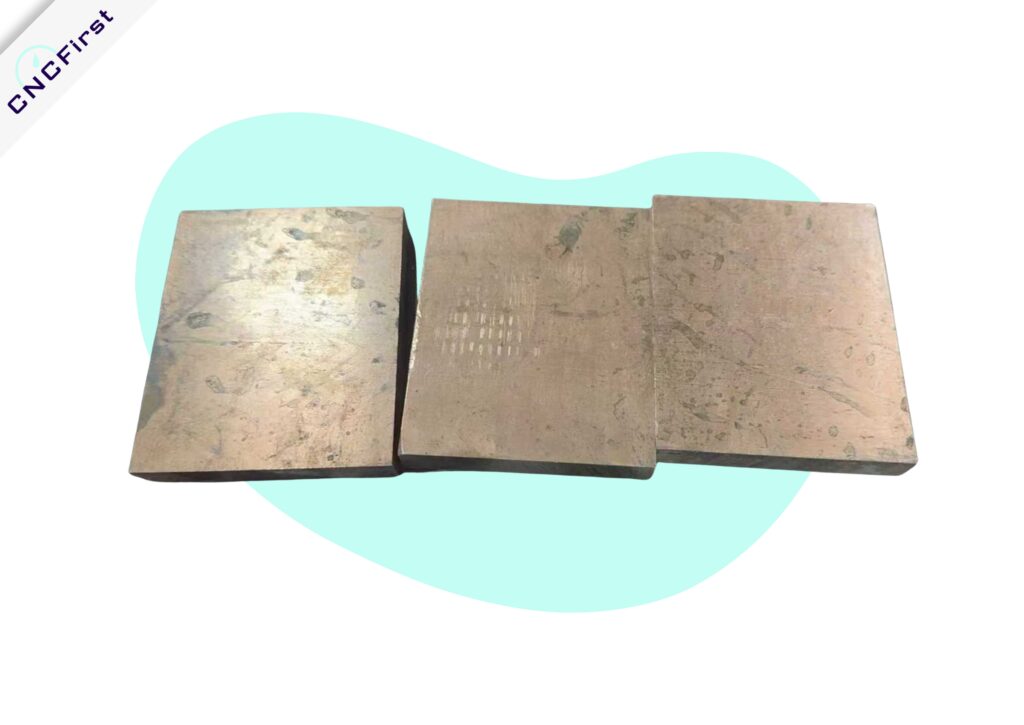
Mechanical Properties of Cu-ETP by Temper
| Temper (EN 1652, sheet/strip) | Tensile strength (MPa) | 0.2% proof strength (MPa) | Elongation A50 (%) |
|---|---|---|---|
| R220 (annealed) | 220–260 | ≤ 140 | ≥ 33 |
| R240 (1/4 hard) | 240–300 | ≥ 180 | ≥ 8 |
| R290 (half hard) | 290–360 | ≥ 250 | ≥ 4 |
| R360 (hard) | ≥ 360 | ≥ 320 | ≥ 2 |
Values for rod and bar (EN 13601, EN 12163) are similar but depend on diameter; check the mill certificate for your stock. Hardness ranges from roughly 40–65 HV annealed to over 90 HV in the hard tempers.
Advantages and Limitations
- Advantages: very high electrical and thermal conductivity, excellent ductility for cold forming, good corrosion resistance in air and water, widely available at low cost compared with other copper grades.
- Limitations: not suitable for hydrogen atmospheres or hydrogen brazing, moderate strength, and poor machinability compared with brass or tellurium copper.
CNC Milling Cu-ETP 2.0060
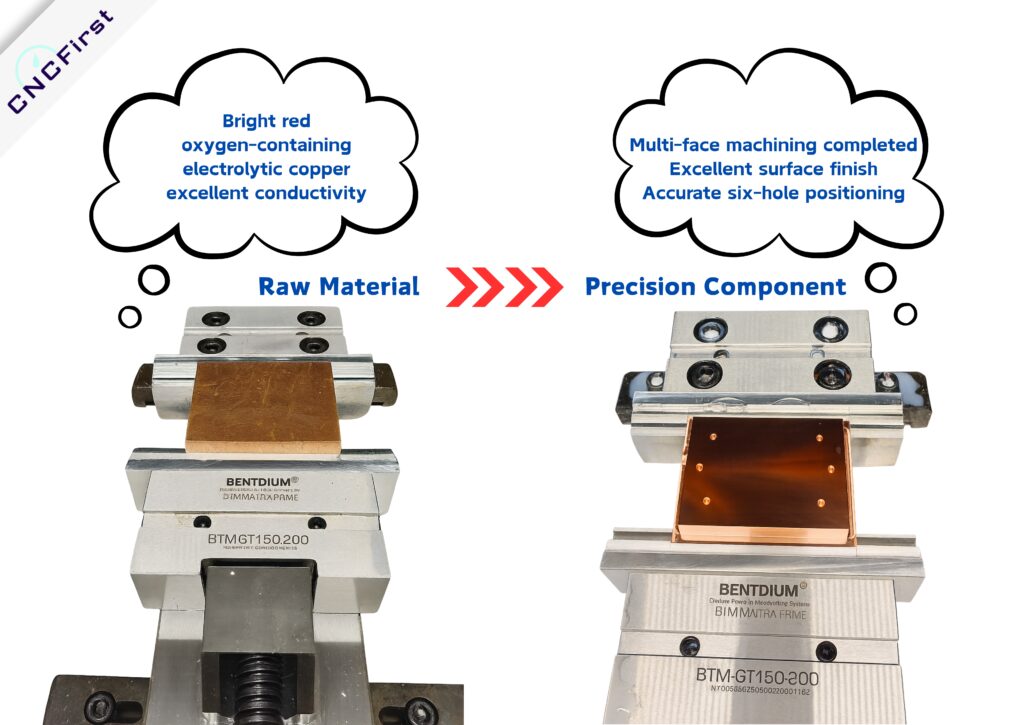
Typical milled parts
- Busbars, connection plates and grounding bars
- Heat sinks, cold plates and heat spreaders
- Contact blocks and multi-face electrical parts
Milling tips
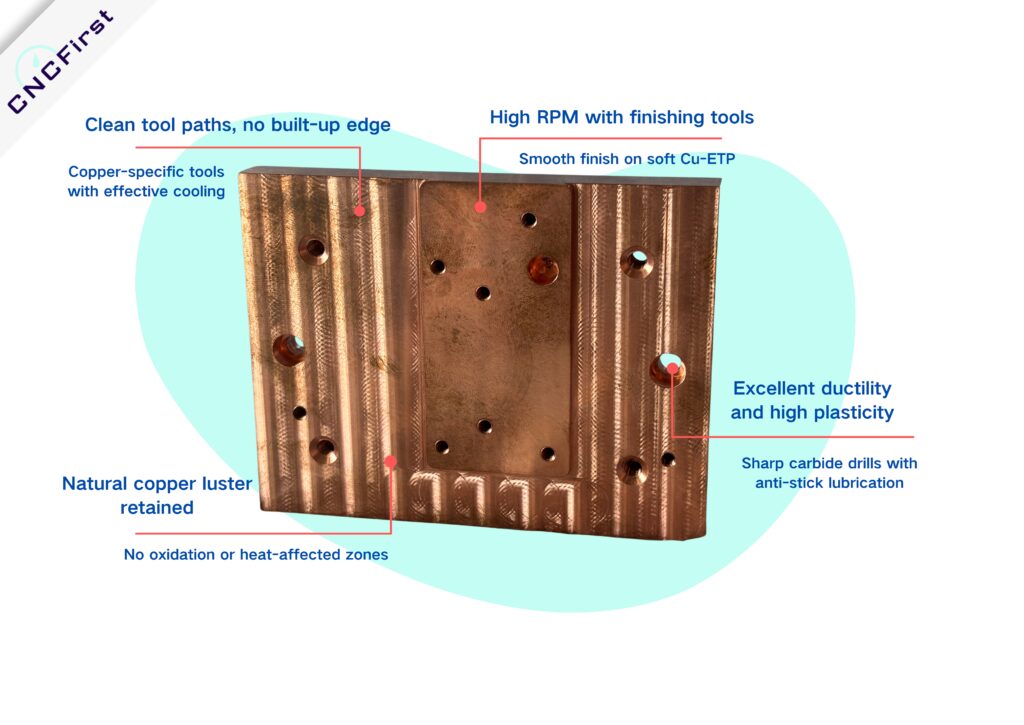
- Use sharp, polished uncoated carbide or DLC-coated end mills with high positive rake. TiN and TiAlN coatings tend to make copper stick to the edge.
- Keep a real chip load. Too low a feed makes the tool rub, smear the copper and build up an edge; a moderate feed with high spindle speed works better than very light cuts.
- Use plenty of coolant (emulsion or oil) aimed at the cutting edge to stop chips welding to the tool and to prevent discoloration.
- Plan finishing passes and deburring: pure copper forms large, tough burrs.
CNC Turning Cu-ETP 2.0060
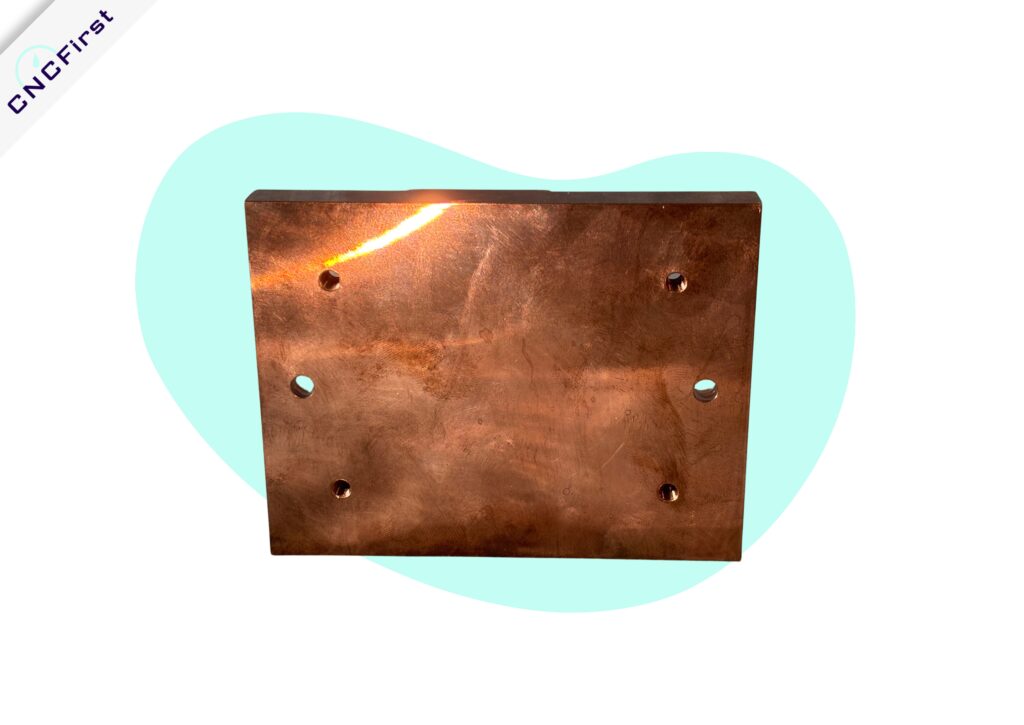
Typical turned parts
- Terminals, contact pins and electrodes
- Rotary joints and bushings for current transfer
- Thin-wall sleeves and rings
Turning tips
- Clamp with soft jaws or wide-contact collets; copper marks and deforms easily. Support long parts with a tailstock or steady rest.
- Use sharp carbide inserts with a polished rake face and an open chip breaker designed for non-ferrous metals.
- Typical finishing feeds are about 0.05–0.15 mm/rev. Avoid dwelling, which work hardens the surface and leaves rub marks.
- Break long, stringy chips with interrupted feed or pecking when drilling.
- Deburr and chamfer edges, and handle finished parts with gloves to avoid fingerprints and tarnish.
When to Choose a Different Copper
If the part has many features and conductivity can drop slightly, tellurium copper (C14500) machines about four times faster than Cu-ETP with roughly 90% IACS conductivity. If you need strength and conductivity, consider chromium copper (C18200). If the part will be brazed in hydrogen or used in vacuum, use oxygen-free copper (Cu-OF, C10200). Our guide to copper grades for CNC machining compares these in detail.
Common Applications of 2.0060 Copper
- Busbars, grounding bars and switchgear contacts
- Electrical connectors, terminals and cable lugs
- Motor and transformer conductors
- Heat sinks, cooling plates and heat exchangers
- Resistance welding and EDM electrodes
Machining 2.0060 Copper Parts at CNCFIRST
We mill and turn Cu-ETP 2.0060 / C11000 parts from prototypes to production. Copper jobs run with dedicated copper tooling and coolant, and we protect parts from scratches and tarnish during deburring and packing. Material certificates and inspection reports can be supplied on request. See our copper CNC machining services, or send your drawing for a quote.
FAQ
What is 2.0060 copper?
2.0060 is the material number for Cu-ETP electrolytic tough pitch copper, formerly called E-Cu57 in DIN 1787. Its EN designation is CW004A and its US equivalent is C11000.
What is the difference between 2.0060 and 2.0065?
2.0060 (E-Cu57) and 2.0065 (E-Cu58) are both ETP copper. The old DIN standard guaranteed a minimum conductivity of 57 MS/m for E-Cu57 and 58 MS/m for E-Cu58. Both are now covered by Cu-ETP / CW004A.
Is 2.0060 the same as C110?
Yes, for practical purposes. C11000 (often written C110) is the US designation for electrolytic tough pitch copper and is the standard equivalent of 2.0060 / Cu-ETP.
What is the density of Cu-ETP?
About 8.94 g/cm³ (8,940 kg/m³).
Can Cu-ETP be welded or brazed?
It can be soldered and brazed in air, but it is not suitable for hydrogen brazing or high-temperature work in reducing atmospheres because of hydrogen embrittlement. For welded or hydrogen-brazed parts, use oxygen-free or phosphorus-deoxidized copper.