CNC milling is the most widely used machining process for making precise metal and plastic parts. This guide explains what CNC milling is, how it works step by step, the main types of milling machines and operations, what tolerances and finishes it can achieve, and how to design parts that are economical to mill. It is written from the perspective of a machine shop that mills parts every day.
What Is CNC Milling?
CNC milling is a subtractive machining process in which a rotating multi-tooth cutting tool removes material from a workpiece, with the tool and table movements controlled by a computer program. The workpiece is clamped on the machine table, and the spinning cutter moves along programmed paths to cut flat faces, pockets, slots, holes, contours and 3D surfaces.
“CNC” stands for computer numerical control. Instead of an operator turning handwheels, the machine follows G-code generated from a 3D CAD model, so the same part can be made repeatedly with the same accuracy.
CNC Milling at a Glance
| Item | Typical value |
|---|---|
| Process | Rotating cutter, workpiece fixed on a moving table |
| Common machines | Vertical and horizontal machining centers, 3-, 4- and 5-axis |
| Typical tolerance | ±0.05 mm standard; ±0.01 mm on critical features |
| Typical surface finish | Ra 3.2 μm as machined; Ra 1.6 μm or better with finishing passes |
| Materials | Aluminum, steel, stainless steel, titanium, brass, copper, plastics |
| Quantities | One prototype to thousands of parts |
| Best for | Prismatic parts: housings, brackets, plates, manifolds, molds |

How Does CNC Milling Work?
- CAD model: the part is designed in 3D CAD and a 2D drawing specifies tolerances, threads and finish.
- CAM programming: a programmer selects tools, cutting speeds and feeds, and generates tool paths for roughing, finishing, drilling and tapping. The CAM software outputs G-code.
- Setup: the machinist clamps the stock in a vise or custom fixture, loads the tools into the tool changer and sets the work and tool offsets.
- Machining: the machine runs the program. Roughing removes most of the material quickly; finishing passes bring features to final size and finish. The automatic tool changer swaps tools between operations.
- Additional setups: if features are on several faces, the part is flipped or re-fixtured, or machined on a 4- or 5-axis machine to avoid extra setups.
- Deburring and inspection: edges are deburred, and dimensions are checked with gauges or a CMM before finishing and shipping.
Types of CNC Milling Machines
Vertical Machining Centers (VMC)
The spindle is vertical and the tool points down at the table. VMCs are the most common milling machines: versatile, easy to set up and suitable for most plates, brackets, housings and molds.
Horizontal Machining Centers (HMC)
The spindle is horizontal. Chips fall away from the part, and HMCs usually have a rotary table and pallet changer, so four sides of a part can be machined in one setup while the next part is loaded. They are used for production of larger, multi-sided parts such as engine and gearbox housings.
Knee Mills and Bed Mills
On a knee mill the table sits on a vertically adjustable knee; it is common for manual and toolroom work. On a bed mill the table moves only horizontally on a rigid bed and the spindle head moves vertically, which supports heavier workpieces and cuts.
Gantry (Bridge) Mills
The spindle is carried on a bridge over a large table. Gantry mills machine very large parts such as machine bases, molds and aerospace structures.
3-Axis, 4-Axis and 5-Axis Milling
| Machine | Axes | Best for |
|---|---|---|
| 3-axis | X, Y, Z linear | Parts machined from one or a few sides; most common and lowest cost |
| 4-axis | X, Y, Z + one rotary (A) | Features around the sides of a part, cam profiles, cross holes |
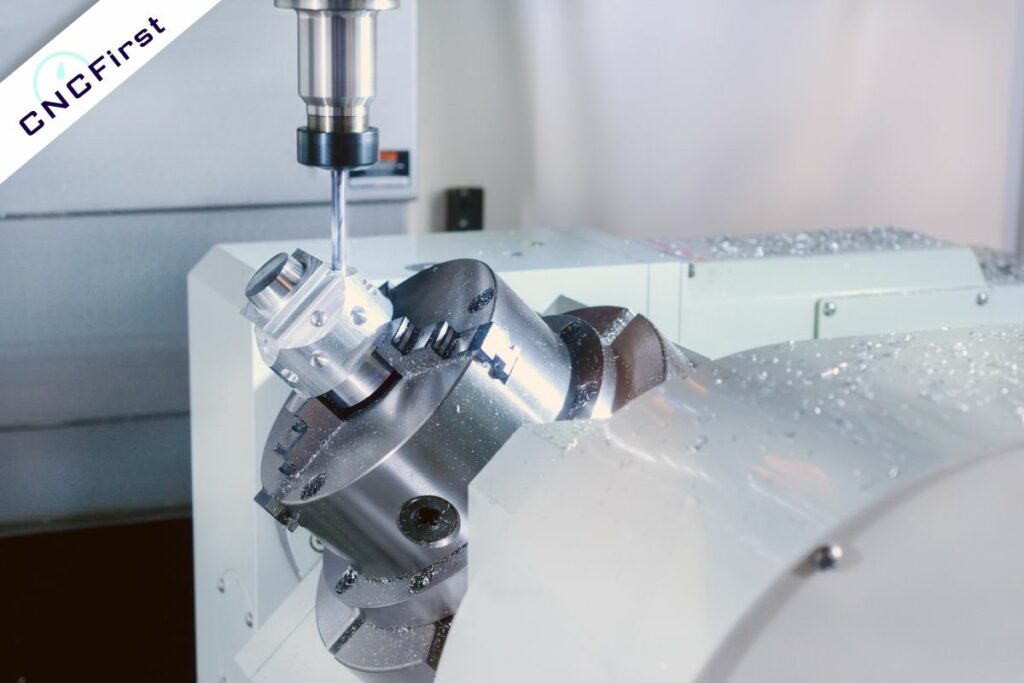
| 5-axis | X, Y, Z + two rotary | Complex multi-face parts, impellers, compound angles, fewer setups |
See what is 5-axis CNC machining for a deeper comparison.
Common CNC Milling Operations
- Face milling: a face mill with cutting edges on its face and periphery produces large flat surfaces.
- Peripheral (plain or slab) milling: the side of the cutter machines a surface parallel to the cutter axis.
- End milling: an end mill cuts with its end and sides to make pockets, slots, steps and contours. It is the most common milling operation on CNC machines.
- Slotting and pocketing: machining enclosed slots and cavities.
- Contour and 3D surface milling: ball or bull-nose end mills follow curved surfaces, as in molds and impellers.
- Drilling, tapping and thread milling: holes and threads made on the same machine.
- Chamfering and deburring: edge breaks made with chamfer mills.
For details and diagrams, see 15 common types of milling operations.

Materials for CNC Milling
Almost any machinable material can be milled. Aluminum (6061, 7075) is the most common because it machines fast and is light and strong. Steel and stainless steel are used for strength and wear; titanium for strength-to-weight and corrosion resistance; brass and copper for conductivity and appearance; and plastics such as POM, nylon and PEEK for insulating, low-friction and lightweight parts.
CNC Milling Design Tips
- Add internal corner radii slightly larger than a standard cutter radius; sharp internal corners cannot be milled.
- Keep pocket depth to about 4 times the cutter diameter or less to avoid long, vibrating tools.
- Keep metal walls at least about 0.8 mm thick and plastic walls about 1.5 mm.
- Use standard hole sizes and thread sizes, and limit thread depth to about 1.5–2 times the diameter.
- Design features to be reached from as few directions as possible to reduce setups.
- Apply tight tolerances only to critical features.
See design for manufacturing in CNC machining for more.
CNC Milling vs CNC Turning
Milling rotates the tool and keeps the part still, so it suits flat and prismatic parts. Turning rotates the part against a stationary tool, so it suits round parts. Many parts use both. Read CNC milling vs CNC turning.
Advantages and Limitations of CNC Milling
- Advantages: high accuracy and repeatability, complex shapes, wide material choice, no tooling cost, suitable from one-off prototypes to production.
- Limitations: material waste compared with casting or forging, higher unit cost at very high volumes, and geometry limited by tool access (no sharp internal corners, limited deep narrow cavities).

CNC Milling Services at CNCFIRST
We mill aluminum, steel, stainless steel, titanium, brass, copper and plastic parts on 3-, 4- and 5-axis machining centers in China, from prototypes to production, with ISO 9001 and IATF 16949 certified quality control. See our CNC milling services or send a drawing for a quote.
FAQ
What is a CNC milling machine?
A machine tool that holds a rotating cutter in a spindle and moves it relative to a workpiece under computer control. Modern CNC mills with automatic tool changers are called machining centers.
What is the difference between CNC milling and CNC machining?
CNC machining is the general term for computer-controlled material removal, including milling, turning, drilling and grinding. CNC milling is one type of CNC machining.
How accurate is CNC milling?
Standard tolerances are about ±0.05 mm, and ±0.01 mm or better can be achieved on critical features, depending on part size, material and machine.
How much does CNC milling cost?
Cost depends mainly on machine time, number of setups, material and tolerances. In China, CNC machine time is typically about $10–20 per hour. See CNC machining costs in China.